

All products presented on this website are subjected to extensive checks from our team of engineers and mechanics. Althought,we can not offer a full guarantee for any of our products, as they are used parts from third parties. The limited liability guarantee that comes with these products is extensively analysed here. Please contact our Support Lineif you have any questions about our products guarantee.
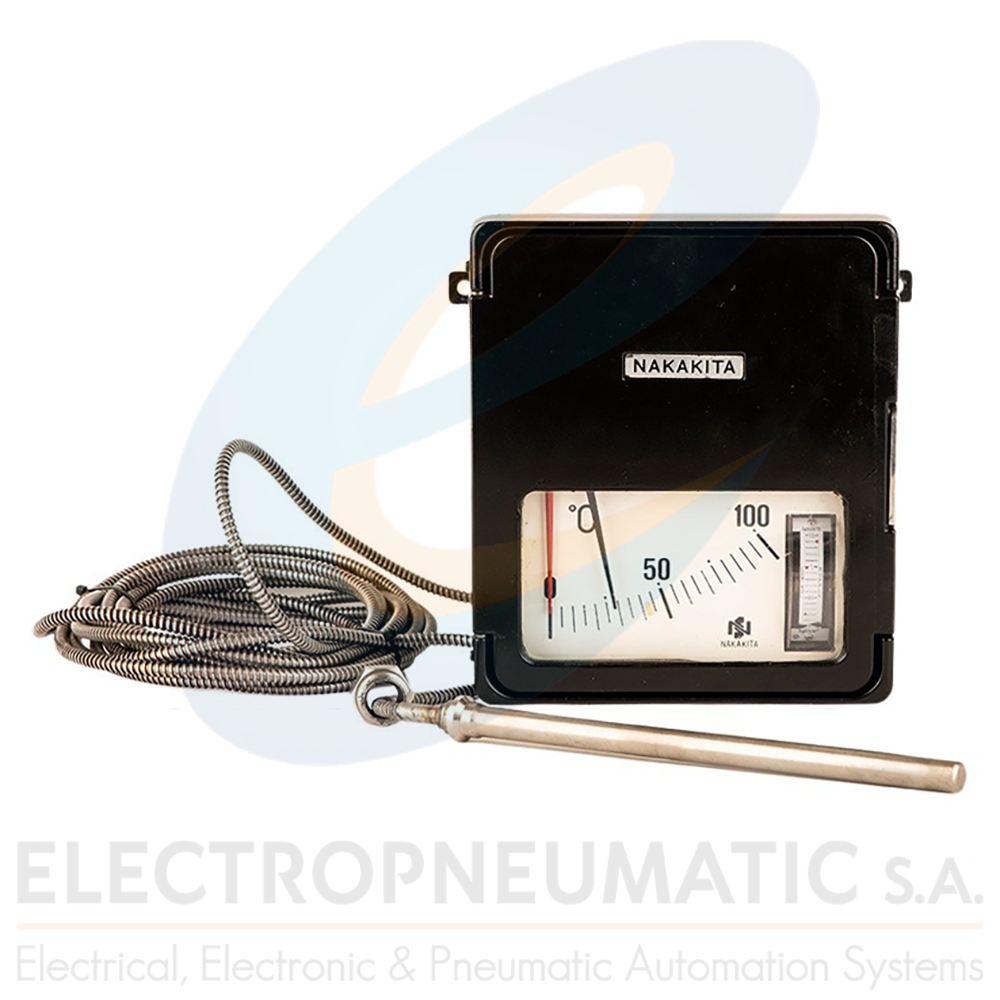
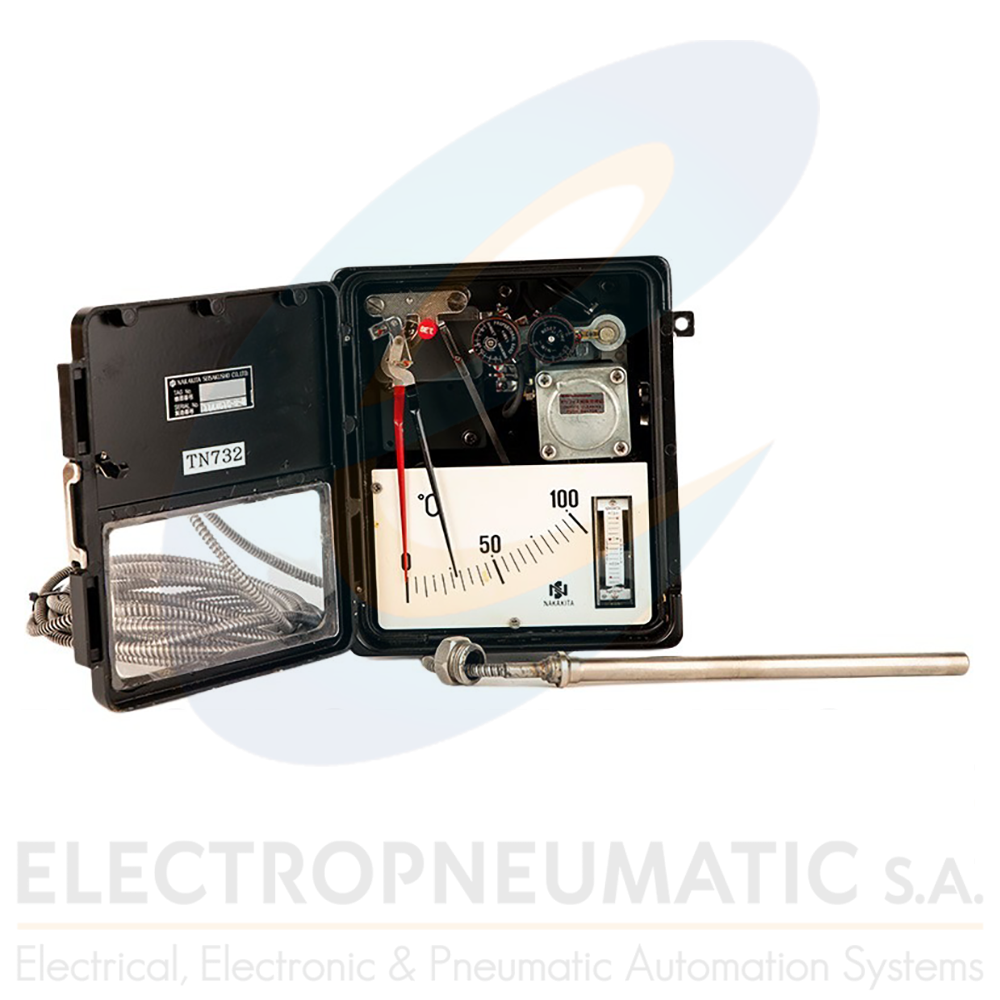
ΝΑΚΑΚΙΤΑ TEMPERATURE CONTROLLER 0-100°C

- TEMPERATURE CONTROLLER
- 0-100°C
- WITH CAPILLARY
In stock

Fast Shipping
Worldwide!

More than 2.000
products available!

Support
from experts!

5-star ratings
from worldwide clients!
ℹ️ Additional Information
| Condition | USED/GOOD WORKING CONDITION |
|---|---|
| Manufacturer | NAKAKITA |
| Product Code | 100.104.00070 |
📦 Guarantee Terms
🗂️ Product Files
Documents
🖹 Description
Type : NSTM 732
Range: 0-100°C
Air Pressure: 1.4 kg / cm2
Control Pressure: 0,2 – 1,0 kg / cm2
The temperature indicating controller model NSTM 732 by Nakahita Seisakusho Co., Ltd. is a reliable mechanical/pneumatic control device designed for accurate temperature monitoring and regulation in industrial systems. It belongs to the category of traditional controllers that operate without complex electronics, making it ideal for robust and fail-safe applications.
What It Is
The NSTM 732 is a temperature indicating controller that measures temperature via a remote probe and compares it to a predefined setpoint. Based on this comparison, it controls a process either through a pneumatic signal or by activating a switch.
What It Does
This device combines measurement and control functions:
- Measures temperature using a capillary probe
- Compares the measured value with a setpoint
- Automatically adjusts the process via control output
It is widely used in systems where stable temperature control is essential.
Design and Components
The controller features a classic industrial design:
- Front dial (0–100°C): Displays current temperature and allows easy monitoring
- Capillary tube and probe: Enables remote temperature sensing
- Controller housing: Contains the internal mechanical control mechanism
- Output mechanism: Provides pneumatic signal or switching action
How It Works
The operation is based on thermal expansion principles:
- Temperature changes at the probe
- Fluid inside the capillary expands or contracts
- This movement is transmitted to the internal mechanism
- The controller responds by:
- Sending a pneumatic signal, or
- Activating a switch
This allows continuous or ON/OFF control depending on the configuration.
Typical Applications
The NSTM 732 is commonly used in:
- Boilers and heating systems
- Hot water systems
- Heat exchangers
- Industrial temperature control processes
Advantages
- No electrical power required (for pneumatic versions)
- Reliable mechanical operation
- Suitable for harsh or hazardous environments
- Low maintenance requirements
Comparison with Similar Devices
| Device | Brand | Function |
| NFT2 | Yamatake | Temperature control (pneumatic) |
| KGTA12 | Yamatake | Temperature control (0–100°C) |
| NSTM 732 | Nakahita | Temperature control (0–100°C) |
All devices perform similar functions using mechanical or pneumatic principles.
In Simple Terms
Think of the NSTM 732 as a mechanical thermostat for industrial systems, capable of maintaining stable temperature without electronics.
Role in a Control System
Temperature process → Controller → Signal (air or switch) → Valve / heater → Regulation
Big Picture
This device belongs to the control layer of industrial automation systems, where decisions are made based on measured values.
Final Insight
Together with pressure controllers, this type of device represents the core “brain” of traditional pneumatic control systems, ensuring stable and safe operation in industrial environments.